 Sure Thing Roofing Contractor
Call Us Now
(678) 781-0045
Sure Thing Roofing Contractor
· FAYETTE COUNTY, GA
Sure Thing Roofing Contractor • Peachtree City, GA • Atlas Pro+ Certified • More than 60 Five-Star Reviews
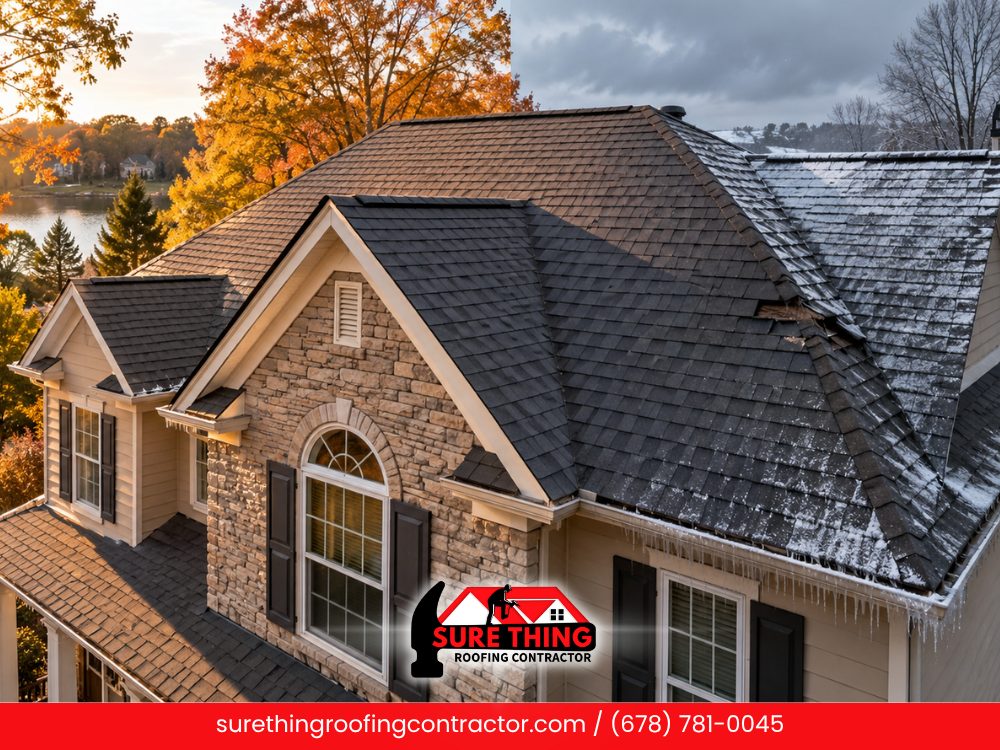
If a roof needs replacing and you are weighing October against April, the honest answer for most Fayette County homeowners is: do it now.
That is not urgency for its own sake. It comes down to three things that genuinely differ between the two seasons — how shingles bond, what a Georgia winter does to a compromised roof, and what happens to pricing and scheduling once spring arrives.
Here is the actual comparison, including the cases where waiting is the right call.
Because asphalt shingles do not fasten themselves. They seal.
Every architectural shingle carries a factory-applied adhesive strip. After installation, warm surface temperatures activate that strip and bond each course to the one below. That bond is what makes a roof a wind-resistant system rather than a collection of individually nailed pieces.
In October, roof surface temperatures in Fayette County are comfortably in the range where that happens within days. In January they frequently are not, and a roof installed in genuine cold may not seal until spring — leaving it vulnerable through exactly the season when wind and ice are most likely.
Competent roofers work in cold weather using hand-sealing and adjusted technique, and there are legitimate winter installations. But it is added labor, added risk and a narrower margin for error. If you have the choice, warm installation is simply better, and October is warm installation season.
A compromised roof does not hold steady through winter. It degrades, and the degradation compounds.
Freeze-thaw cycling. Central Georgia crosses freezing repeatedly through the winter. Water enters an existing gap during the day, freezes and expands overnight, and the gap widens. A small opening in October is a meaningfully larger one by March through nothing but repetition.
Ice events. Georgia gets ice more reliably than heavy snow, and ice loads the roof edge and the trees above it. A roof already at end of life is the one that loses shingles when that happens.
Decking damage. This is the expensive part. A leak that runs all winter does not just stain a ceiling — it saturates the roof deck. Replace in October and you may be replacing shingles. Replace in April after a wet winter and you may be replacing shingles plus sections of decking, insulation and drywall. The project scope grows while you wait.
Interior consequences. Prolonged moisture in an attic supports microbial growth and damages insulation, both of which are separate remediation costs that had nothing to do with the roof itself.
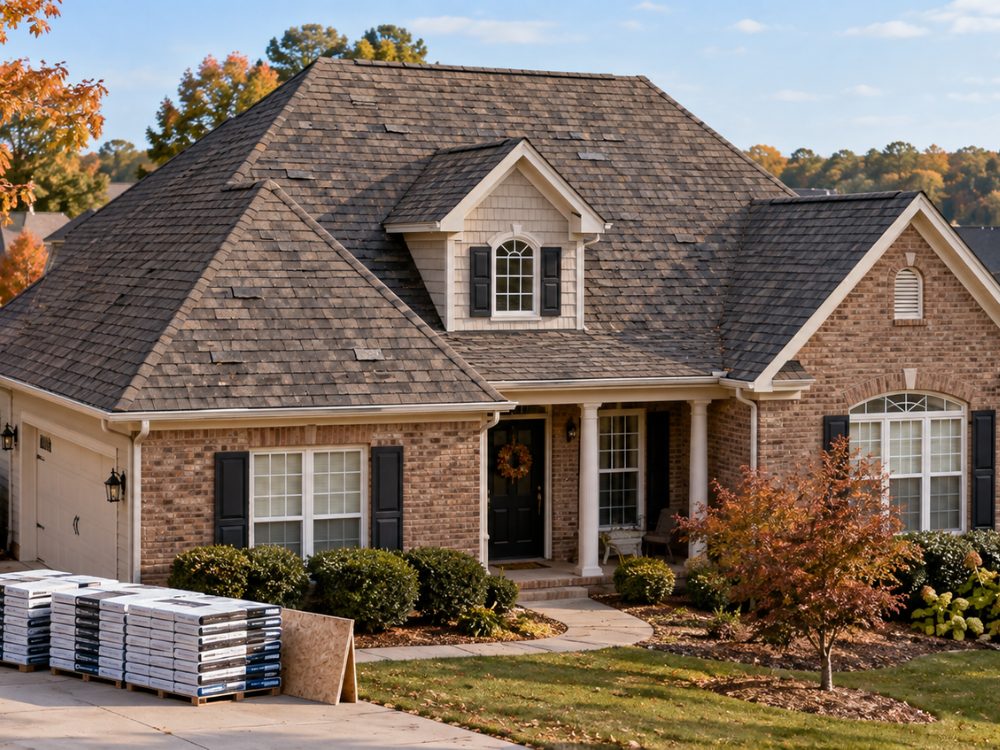
This is the practical argument, and it is a real one.
Right now crews across Fayette and Coweta County are working normal schedules. You can get an assessment quickly, compare quotes without pressure, and pick an installation date that suits you.
That changes in spring. Storm season arrives, insurance claims surge, and every roofer in the south metro is booked. Homeowners who waited find themselves competing for calendar slots with everyone whose roof failed over the winter, frequently on someone else's timeline. The homeowner who scheduled in October chose their date. The homeowner who waited takes what is available.
If you are planning to list, this is the strongest case of all for acting now.
A roof at end of life is one of the first things a buyer's inspector documents and one of the largest single items a buyer will price against you. It affects insurability too — Georgia carriers care about roof age and condition, and a buyer who cannot get a policy written comfortably is a buyer whose lender gets nervous.
Replacing in October means you list in spring with a new roof, documentation, and one less thing to negotiate. Discovering it in March means you either take the price reduction or scramble for a crew in the busiest month of the year.

There are legitimate cases, and it is worth being straight about them.
What is not a good reason is hoping it holds. A roof that is leaking now leaks worse in February, and the bill grows with it.
Get an assessment, and get one that gives you a condition report rather than a verdict.
A proper evaluation covers the shingle surface — granule loss, curling, cracking, blistering and lost seals; the flashing at every transition, chimney, valley and skylight; vent boot collars, which UV destroys on a predictable Georgia schedule; the decking condition where it can be assessed; the gutters and drainage; and the attic from underneath, where staining, damp sheathing, rust on nail shanks and daylight tell you what the surface cannot.
That assessment should end with a straight answer to one question: is this a repair, or is this a replacement? A roofer who cannot make that distinction clearly, with photographs, is not giving you what you need to decide.
Worth knowing what the industry standards say too. Manufacturer warranties and installation requirements are documented, and the National Roofing Contractors Association publishes guidance on roofing practice. Georgia licenses contractors through the State Board of Residential and General Contractors, and verifying licensing and insurance is something every homeowner should do before signing anything.
For most homeowners here, yes. Temperatures let shingles seal properly, crews have availability before the spring rush, and you avoid a winter of freeze-thaw cycling on a roof that is already compromised.
Yes, and sometimes it must be. It requires adjusted technique and hand-sealing, and the shingles may not fully bond until warmer weather. It is a legitimate option for an emergency; it is not the preferred choice when you have the option to schedule.
The scope grows. A leak running through winter saturates decking and insulation, which turns a shingle replacement into a shingle-plus-decking-plus-interior repair. That is the single most common way a manageable project becomes an expensive one.
Scheduling is easier and you have more room to compare quotes without deadline pressure, which is worth real money. But the honest reason to move now is condition and installation quality, not a seasonal discount — be skeptical of anyone selling urgency on price alone.
If the roof is at end of life, it is usually worth it. It is among the first things a buyer's inspector documents and one of the largest items a buyer prices against you, and it affects insurability. Doing it in October means listing in spring with documentation instead of a negotiation.
Age, the extent of granule loss and seal failure, the number and location of problem areas, the condition of the decking, and whether previous repairs have held. A proper assessment with photographs should give you a clear answer, not a vague recommendation.
Peachtree City and the surrounding south metro Atlanta area — Fayetteville, Tyrone, Newnan, Senoia, Sharpsburg and the Fayette and Coweta County communities. Call to confirm availability for your address.
The question is not really fall versus spring. It is whether you want to choose your timeline or have winter choose it for you. Get a straight roof assessment from Sure Thing Roofing Contractor — call Josh at (678) 781-0045 and find out whether you are looking at a repair or a replacement before the cold makes the decision.
Not sure what your roof needs yet? See the full range of roofing services, from targeted repair through full replacement.
If you have a leak, visible storm damage, or a roof that simply has not been looked at in the last few years, do not wait. A no-cost inspection costs you nothing and gives you the honest picture of where your roof stands.
Monday through Saturday, 9 AM to 6 PM. We confirm within one business hour.
Schedule Your No-Cost Roof InspectionOr call us directly: (678) 781-0045
Serving Peachtree City, Fayetteville, Newnan, McDonough, Senoia, Sharpsburg, Griffin, and Douglasville.
Peachtree City’s Atlas Pro+ certified roofer — since 2015. More than 60 five-star reviews.