 Sure Thing Roofing Contractor
Call Us Now
(678) 781-0045
Sure Thing Roofing Contractor
· PEACHTREE CITY, GA
Sure Thing Roofing Contractor • Peachtree City, GA • Atlas Pro+ Certified • More than 60 Five-Star Reviews
It happens every year once the cold nights arrive. A Peachtree City homeowner goes into the attic for the holiday decorations and finds damp insulation, dark spots on the underside of the roof deck, or drops of water hanging from the nail tips. Or a stain appears on a bedroom ceiling after a cold, clear week without a drop of rain.
The natural assumption is a roof leak. Sometimes it is. But when the moisture shows up in cold weather and not after storms, the more likely culprit is condensation — and the fix is not new shingles. It is ventilation and airflow.
Here is how winter attic condensation happens, how to tell it apart from a leak, and why it matters to the life of your roof.
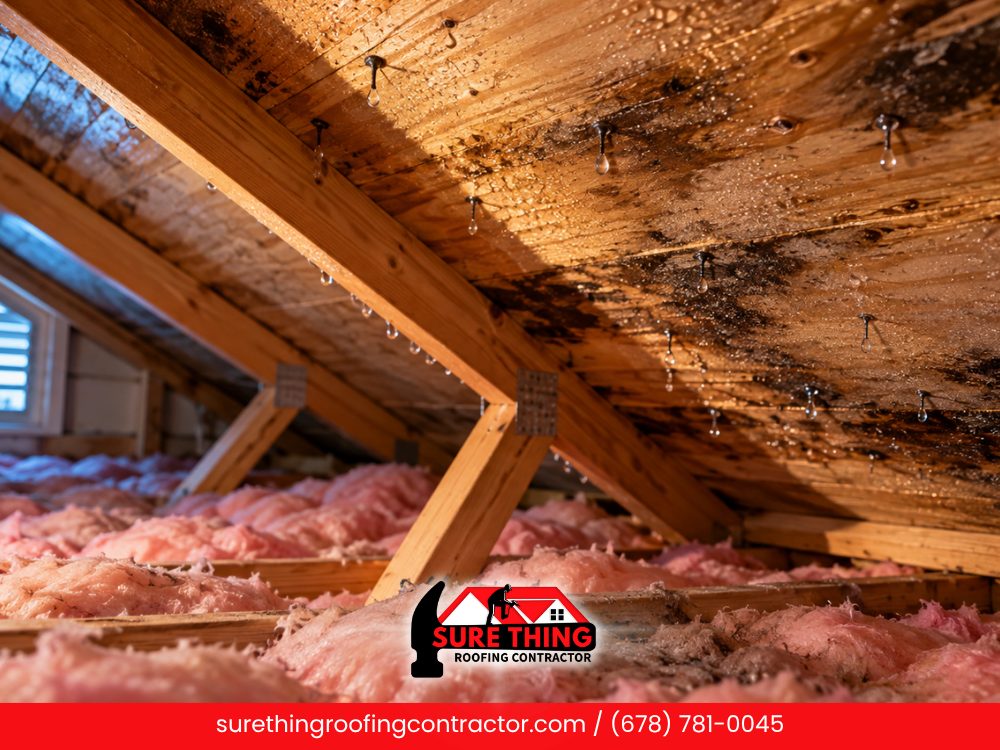
Warm air holds more moisture than cold air. Every house produces moisture — showers, cooking, laundry, breathing — and some of that warm, moist air works its way up into the attic through gaps around light fixtures, the attic hatch, plumbing and wiring penetrations, and the tops of interior walls.
On a cold, clear night the roof deck can get very cold, because the roof loses heat to the open sky. When warm, moist air reaches that cold wood, it hits its dew point and the water comes out of the air, right onto the underside of the sheathing and onto the roofing nails that poke through it. On colder nights it can form frost. When the sun comes up and the roof warms, the frost melts and drips into the insulation below.
A properly ventilated attic handles this. Cool, dry outside air comes in low at the soffits, moves up along the underside of the roof deck, and leaves high at the ridge or roof vents, carrying the moisture out with it. When that airflow is blocked, unbalanced or overwhelmed, the moisture stays.
Because the house is doing more of everything. More people staying over, more showers, more cooking, more laundry, and the heat running with the windows shut. A house full of guests over Thanksgiving puts noticeably more moisture into the air than a quiet week in October — and the attic is where any excess ends up if it has no way out.
That is why so many homeowners first notice the problem in late November or December, often while pulling decorations out of the attic.
Timing and pattern are the biggest clues.
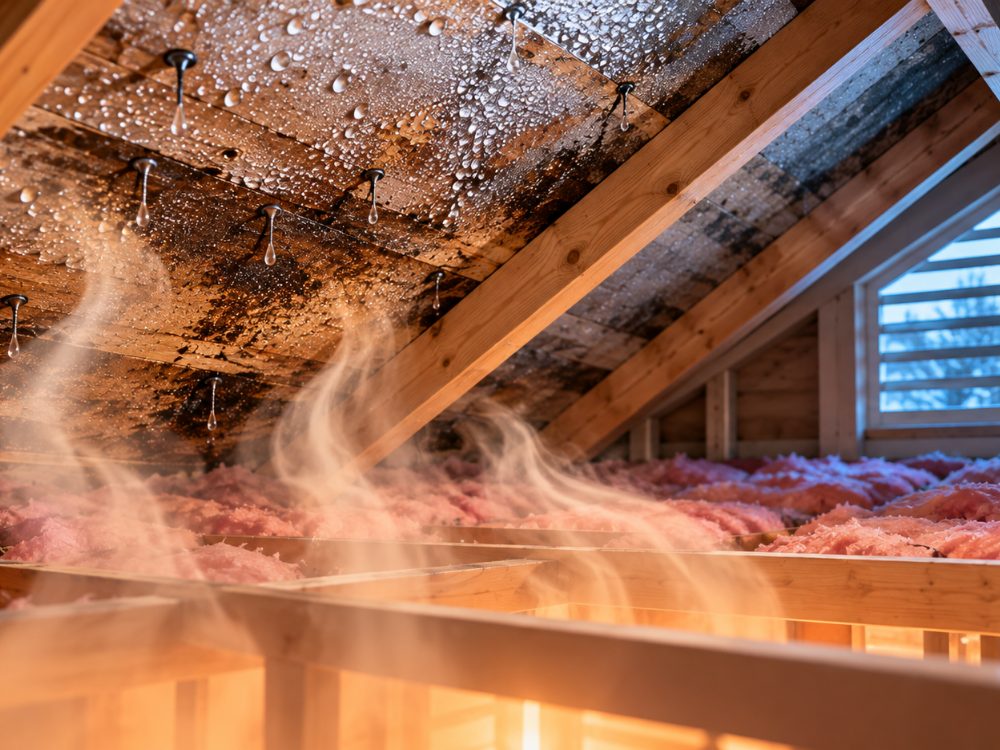
It is possible to have both, which is why the attic and the roof surface should be evaluated together rather than guessing from one side.
Most winter condensation problems come down to a handful of causes.
Intake vents at the soffits are where the fresh air enters. When insulation is blown or pushed over them — very common after an insulation upgrade — the attic loses its intake, and the exhaust vents at the top have nothing to pull from. Baffles that hold insulation back from the soffits are what keep that path open.
A bathroom exhaust fan is meant to move moist air out of the house, not into the attic. Yet fans ducted into the attic space, or with a duct that has fallen off and now blows onto the insulation, are one of the most frequent causes of winter condensation. The same goes for a dryer vent that terminates in the attic. These need to be ducted all the way outside through a proper roof or wall termination.
Exhaust vents should work with the intake, not against each other. When a roof has a ridge vent plus gable vents, or a powered attic fan alongside passive vents, the airflow can short-circuit — pulling air in through one high vent and out the next — while the lower part of the attic stays stagnant. More vents is not automatically better ventilation.
The International Residential Code, the model code that most U.S. residential building codes are based on, sets a general minimum amount of net free vent area relative to the attic floor area, and shingle manufacturers publish ventilation requirements of their own. A home that was under-ventilated from the start, or lost ventilation during a re-roof or remodel, will show it in the winter.
Ventilation removes moisture, but the less moisture that gets into the attic in the first place, the better. Gaps around recessed lights, attic hatches, pull-down stairs and ceiling penetrations let warm, moist air flow straight up. Sealing those is often work for an insulation or air-sealing contractor, and it pairs naturally with a ventilation correction.
Left alone, it works on the roof from the inside.
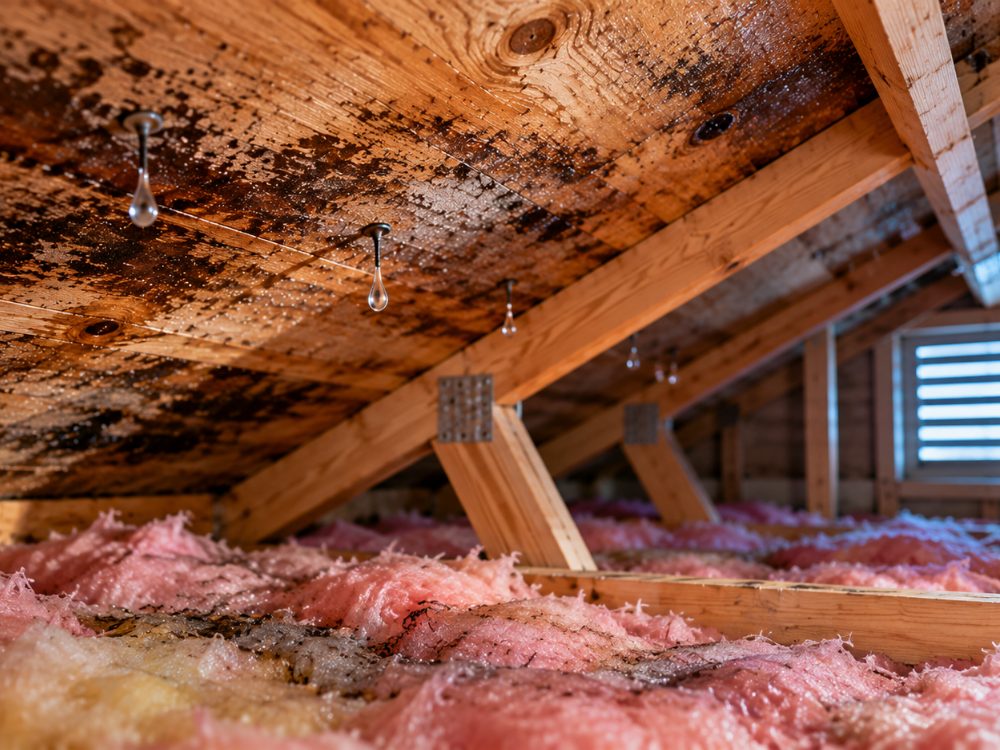
Repeated wetting of the roof deck can lead to mold and mildew on the sheathing, delamination of plywood or OSB, and softened decking that feels spongy underfoot. Wet insulation loses much of its effectiveness and can compress. Rusting nails can lose holding power. And because proper ventilation is part of many shingle manufacturers' installation requirements, an attic that is not ventilated correctly can become a problem if a warranty question ever comes up.
Poor ventilation is a year-round issue. In a Georgia summer it lets heat build up under the deck; in winter it traps moisture. A roof that is losing on both fronts will not reach the service life it should.
Start with the easy checks, then get the attic and roof looked at together.
Sure Thing Roofing Contractor checks attic ventilation as part of its 7-Point Roof Tune-Up, and a no-cost roof inspection is a straightforward way to find out whether the moisture in your attic is coming from the roof, from inside the house, or from both. If the roof is near the end of its life anyway, a roof replacement is the ideal time to get the ventilation right from the start.
If you have not done your seasonal checklist yet, the fall roof maintenance guide covers the outside of the roof — this post covers what is happening underneath it.
A small amount of frost on the coldest mornings can happen, but repeated frost, dripping nails or damp insulation are signs that moisture is getting into the attic faster than the ventilation can remove it. That is worth having evaluated before it damages the roof deck.
Compare it with the weather. A stain that appears or grows after rain points to a leak. One that shows up after cold, clear nights points to condensation. Checking the attic above the stain — the deck, the nails and the insulation — usually tells the story, and both can be present at once.
Yes. It sends warm, moist air directly into the coldest part of the house, where it condenses on the roof deck. Bath fans and dryer vents should be ducted all the way outside through a proper roof or wall termination.
Not necessarily. Ventilation depends on balanced intake at the soffits and exhaust up high. Adding the wrong vent, or mixing exhaust types, can short-circuit the airflow. The intake, the exhaust and the moisture sources need to be evaluated together.
It can. Shingle manufacturers publish ventilation requirements as part of their installation guidelines, so ventilation is worth confirming whenever a roof is installed or replaced, and worth correcting when a problem is found.
Peachtree City and the surrounding south metro Atlanta area — Fayetteville, Tyrone, Newnan, Senoia, Sharpsburg and the Fayette and Coweta County communities. Call to confirm availability for your address.
A wet attic in winter is your roof telling you something while it is still cheap to listen. Get a straight answer from Sure Thing Roofing Contractor — call Josh at (678) 781-0045 and find out whether it is condensation, a leak, or both, before the holidays fill the house.
If you have a leak, visible storm damage, or a roof that simply has not been looked at in the last few years, do not wait. A no-cost inspection costs you nothing and gives you the honest picture of where your roof stands.
Monday through Saturday, 9 AM to 6 PM. We confirm within one business hour.
Schedule Your No-Cost Roof InspectionOr call us directly: (678) 781-0045
Serving Peachtree City, Fayetteville, Newnan, McDonough, Senoia, Sharpsburg, Griffin, and Douglasville.
Peachtree City’s Atlas Pro+ certified roofer — since 2015. More than 60 five-star reviews.